


How to Protect Your Trees During Construction and Trenching in Seffner

A lot of tree damage does not happen during a storm.

It happens during a project.
A new fence goes in. A driveway gets widened. A shed pad gets cleared out. Utility lines get installed. Somebody brings equipment into the yard, the work gets done, and everything looks fine for a while. Then a few months later the tree starts thinning out, leaning, dropping limbs, or just looking stressed in a way it never did before.
That is the part homeowners hate, because the damage does not always show up right away.
If you are in Seffner or nearby areas like Brandon, Valrico, Plant City, Riverview, Dover, Thonotosassa, or Mango, this is a really important topic. UF IFAS says construction can damage trees in several ways, including branch breakage, trunk wounds, soil compaction, and root damage from digging and trenching. UF IFAS also says cutting roots during utility installation can severely damage a tree because many roots sit just below the soil surface.
The biggest misconception is that if the trunk looks okay, the tree is okay
This is where a lot of homeowners get fooled.
People naturally look at the trunk first. If the bark is not scraped up and the canopy still looks green, they assume the tree made it through the project just fine.
But construction damage often starts underground.
UF IFAS explains that cutting roots for any reason under existing trees can severely damage them, and that many roots are located just below the surface of the soil. Even cutting smaller roots over long stretches can interrupt water supply to the tree.
So the real question during construction is not just, “Did we hit the trunk?” It is, “What happened inside the root zone?”
Why trenching is one of the biggest tree killers
Trenching feels narrow and controlled, so people often assume it is not a big deal.
But roots spread much farther than most homeowners realize, and many of the important ones are not deep.
UF IFAS says digging and trenching during construction can cause root damage and that severing a major root can remove about 5 to 20 percent of a tree’s root system. They also note that when significant digging and trenching happens, the chance of the tree falling over increases.
That is a huge deal in Florida, where storms can test a tree’s stability long after the construction crew is gone.
Utility work is one of the most common ways trees get damaged
This shows up all the time in real yards.
Cable lines. Water lines. Sewer lines. Irrigation. Drainage adjustments. Electric work. Fiber upgrades.
UF IFAS specifically says cutting roots when installing utilities such as cable, water, and sewer lines under existing trees can severely damage the tree. They also recommend consulting utility providers before digging because underground infrastructure may be present even when it is not obvious from the surface.
That means a quick trench through the canopy area is not always a “small job.” It can be the start of a long decline.
Soil compaction is quieter than trenching, but it is still a problem
Not all construction damage comes from cutting.
Sometimes the damage comes from weight.
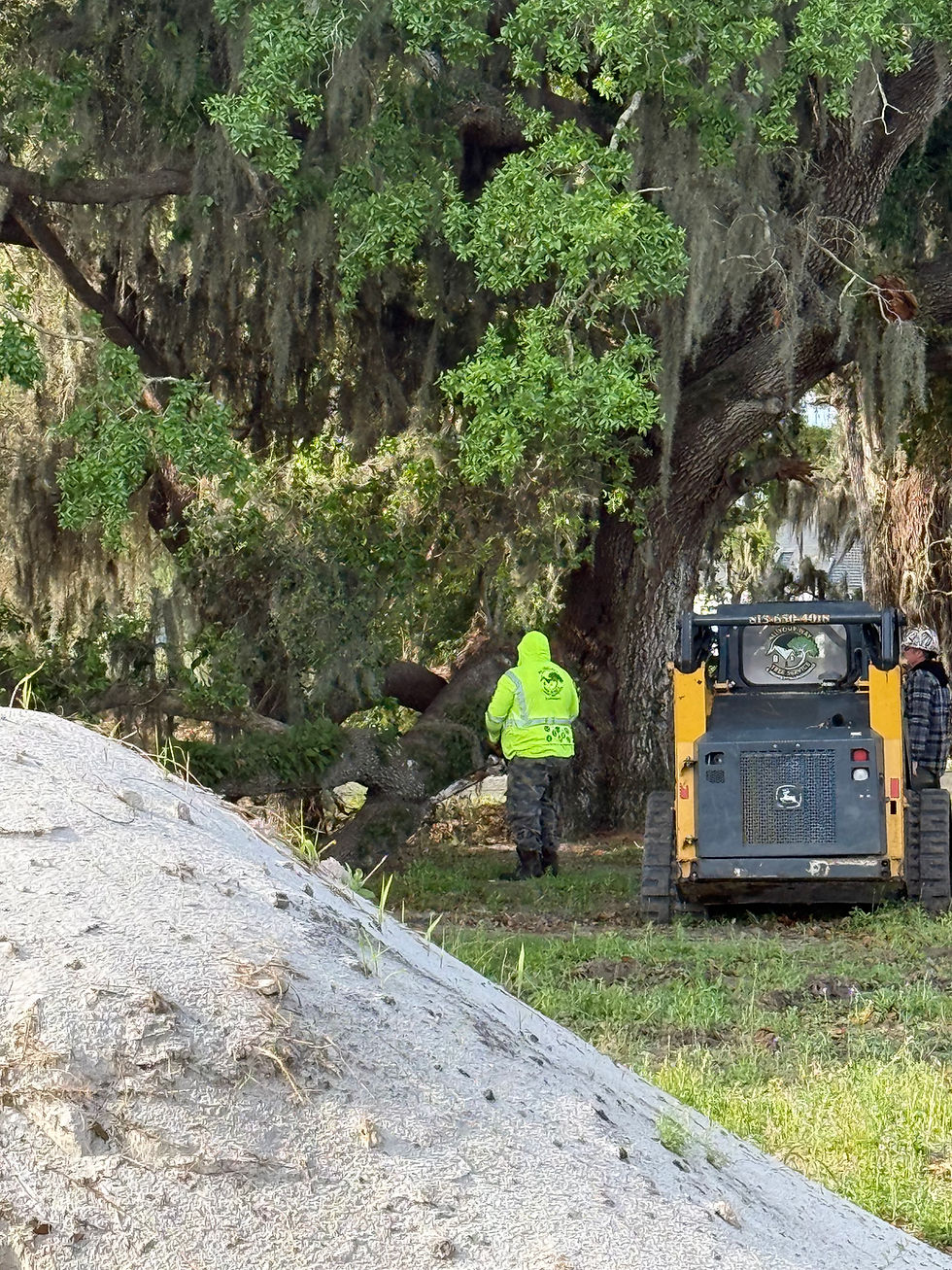
Equipment parked under the canopy. Repeated foot traffic. Materials stacked near the trunk. Vehicles driving over the same area again and again.
UF IFAS Gardening Solutions recommends erecting a temporary fence at the dripline to keep construction equipment away, and it explains that this also helps prevent soil compaction in part of the root zone. UF IFAS also says that if traffic over the root zone cannot be avoided, a 12 inch layer of coarse bark mulch topped with steel plates can help protect roots from vehicle damage.
That is one of those details that sounds overly cautious until you realize how many tree problems start with compacted soil and damaged roots.
The dripline matters more than most people think
A lot of homeowners assume the “safe zone” is just a ring around the trunk.
That is usually not enough.
UF IFAS recommends fencing trees at the dripline during construction, which is basically the outer edge of the canopy. That is because a large part of the root system extends far beyond the trunk itself, and the area under the canopy is a major part of what keeps the tree healthy and stable.
So if a contractor says, “We are not touching the trunk, so the tree is fine,” that is not a full answer.
Trees often look fine at first, then decline later
This is one of the hardest parts for homeowners.
The project finishes. The tree still has leaves. Everybody moves on.
Then later, sometimes months later, you start seeing canopy thinning, dead branch tips, poor growth, or instability in storms.
UF IFAS notes that construction damage can set up future decline and failure, and additional arboriculture research highlighted by UF IFAS says root systems can take many years to recover from trenching damage.
So if a tree starts acting different after a project, that connection is worth taking seriously.
The safest approach is to decide which trees are worth protecting before the project starts
This step saves a lot of regret.
Before construction begins, look at the trees on the property and decide which ones really matter.
Shade trees close to the house
Established trees that add privacy
Healthy trees that would be expensive or impossible to replace
Trees near the project footprint that could be injured
UF IFAS says younger trees generally tolerate construction better than older trees, and that groups of trees tend to survive better than single trees. They also recommend choosing strong, healthy trees to preserve and then protecting them intentionally during the construction phase.
That means you do not just “see what survives.” You make a plan.
If you can reroute the work, do it
This is one of the simplest ways to avoid damage.
UF IFAS says the best solution is often to adjust the location of utility lines, driveways, buildings, and planting holes so roots do not have to be cut under the canopy. They say this directly in their root cutting guidance.
That is not always possible, but when it is, it is usually cheaper than dealing with a damaged tree later.
New construction near existing trees needs extra caution
If you are building something new, the risk goes up.
House additions, slabs, detached garages, pads, patios, and hardscape all affect roots differently.
UF IFAS warns that construction practices such as paving over roots, adding fill, and raising grade can damage trees. Their construction protection guidance focuses on keeping heavy disturbance out of the root zone and protecting the tree well before the first machine shows up.
This is one reason older shade trees often struggle after a remodel even when nobody meant to hurt them.
Do not cut roots casually because they are “in the way”
This one matters a lot.
UF IFAS says roots larger than about one inch are considered large, and cautions that cutting large roots can result in trees toppling over. They also explain that even smaller root cuts over long stretches can disrupt water supply.
So if somebody on the job says, “We will just cut this root and keep going,” that should not be treated like a casual decision.
Underground utilities and trees need more spacing than people expect
This is not just about existing trees. It also affects future planting.
UF IFAS says roots of large maturing trees planted within ten feet of underground municipal utility lines could later be damaged when those utilities need servicing.
That means poor planning creates two problems at once.
The utility company may later damage the tree to service the line, and the tree may also create future site conflicts if planted too close.
What homeowners should ask before construction starts
You do not need to become an arborist. But you do want clear answers.
Ask things like:
Where will trenching happen
Will any work go under the canopy of the tree
How will the root zone be protected from equipment
Will fencing be installed at the dripline
If roots are encountered, what is the plan
Can the trench or utility line be rerouted
Will materials be stored under the tree
UF IFAS construction protection guidance strongly supports fencing the dripline and avoiding traffic and disturbance in that protected zone.
A practical Seffner construction tree checklist
Before work starts, do this.
1 Identify your keep trees
Mark the trees that matter most and do not leave that decision vague.
2 Fence at the dripline if possible
UF IFAS recommends temporary fencing at the dripline to keep equipment out of the root zone.
3 Keep materials and machines out of the root zone
Do not let the “easy staging area” become the protected tree’s slow death.
4 Avoid trenching under the canopy whenever possible
UF IFAS says to adjust utility and construction layout to avoid cutting roots under the canopy.
5 If traffic is unavoidable, protect the soil
UF IFAS recommends a thick mulch layer plus steel plates in unavoidable traffic areas.
6 Get an arborist involved early when the tree is valuable
That is usually much cheaper than guessing wrong and losing the tree later.
What to watch for after the work is done
After the project, keep an eye out for changes that suggest the tree was stressed.
Canopy thinning
Dead branch tips
Sparse leafing
Sudden lean changes
More branch drop than usual
Slow decline over the next year or two
UF IFAS and related arboriculture research both make the point that construction damage can show up later, not always right away.
If you notice those changes, do not assume the tree is just “having a rough season.”
When removal becomes part of the conversation
Sometimes protection is not realistic.
If a tree has already been heavily damaged by past trenching, if major roots must be cut for unavoidable work, or if the tree is too compromised to remain safe after construction, then removal may become the better option.
That is not the first goal, but it is sometimes the honest answer.
Final thoughts
A lot of homeowners think storms are what make trees fail.
Sometimes they are.
But sometimes construction is what weakens the tree, and the storm just finishes the job later.
If you are planning a project in Seffner, the smartest move is to protect the trees before the work starts, not after the damage shows up. Trenching, grade changes, root cutting, and equipment traffic can all create long term problems that are easy to miss in the moment and expensive to fix later.
Call to action
If you are planning construction, trenching, or a utility project near trees you want to keep, get a protection plan in place first. It is a lot easier to preserve a healthy tree than to explain later why it started failing after the project ended.


Comments