


The Hidden Costs of Neglected Trees: Roof Leaks, Driveway Cracks, and Denied Claims

If you’ve ever told yourself “I’ll deal with that tree next month,” you’re not alone. In Florida, trees grow fast, storms roll in quick, and minor issues can snowball into expensive repairs—roof leaks, cracked driveways, fence damage, even insurance headaches. The truth? A little annual maintenance is way cheaper than tearing out rotted fascia or re-pouring concrete.
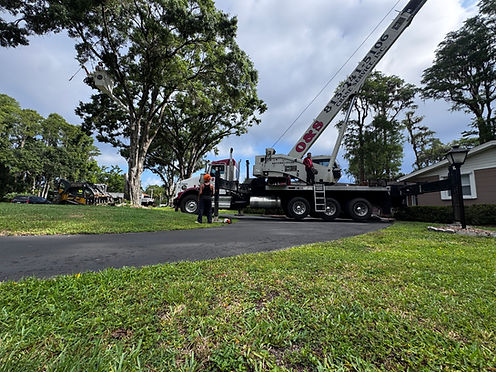
This guide breaks down the real-world failures we see around Seffner, Plant City, and nearby neighborhoods—and exactly what routine care would have prevented them. No scare tactics, no pricing talk. Just clear steps that keep your property safe and your wallet happier.
Not sure where to start? Book a Tree Health Assessment and we’ll map out a simple, sensible plan for your yard.
1) Roof Leaks from Overhanging Limbs (and What to Do Instead)
The scenario: A branch hangs over the roof and sheds leaves year-round. They build up in valleys, gutters, and low-slope sections. After a summer storm, water can’t drain; it backs up under shingles or flashing and finds its way inside. By the time you see the ceiling stain, the plywood is already wet and the insulation is a mess.
What caused it:
Never thinned or reduced end-weight above the roof.
Gutters and valleys clogged by leaf litter and small twigs.
Branch tips rubbing shingles (granule loss) or catching wind like a lever.
What prevents it:
Crown cleaning & reduction to strong laterals above the roofline—no topping.
Seasonal gutter cleanouts (especially pre-storm season).
Structural pruning every 12–24 months to keep end-weight balanced away from the house.
Documentation: a quick job note from a Certified Arborist shows work aligned to industry standards (handy for your records).
Quick win: Add recurring Tree Trimming & Pruning (internal link) before the rainy season and again after leaf drop. Your roof—and your AC bill—will thank you.
2) Driveway and Walkway Cracks (It’s Not “Just the Florida Soil”)
The scenario: Hairline cracks in the driveway become a trip hazard near the expansion joint. A nearby tree has roots wandering under the slab. Mowers scalp the same side weekly, making soil dry and tight. Over time, the slab lifts or settles unevenly and pavers wiggle loose.
What caused it:
Tree planted too close to hardscape or planted too deep (root flare buried).
No root barrier where space is tight.
Irrigation pattern that teases roots toward the slab (cool, moist soil under concrete).
Circling roots from the nursery container never corrected at planting.
What prevents it:
Correct planting (root flare visible; tree set slightly high; wide—not deep—planting hole).
Reasonable spacing: 10–15 ft from foundations for compact trees; 6–10 ft from walks/patios when possible.
Vertical root barriers between the tree and slab when spacing is limited (top edge above soil grade).
Mulch ring to keep mowers and string trimmers off the trunk; roots grow straighter when the base isn’t repeatedly damaged.
Light structural pruning to manage canopy size so you’re not forever “chasing” a too-big tree in a too-small space.
Want a plan that protects concrete and gives you shade? Ask for a Certified Arborist planting layout with species picks and barrier placement.
3) Denied or Complicated Insurance Claims (The Paperwork Nobody Wants)
The scenario: A limb fails in a thunderstorm and damages the roof. You file a claim and the adjuster asks for maintenance history. The photos show an obviously topped canopy with dense, weak sprouts near old cut stubs—or clearly dead wood that’s been there a while. Now you’re stuck explaining “maintenance.”
What caused it:
No documentation of routine, professional pruning.
Improper work in the past (topping, flush cuts, large stubs) that created weak regrowth and decay pockets.
Visible neglect (advanced deadwood, fungal conks, obvious cavities) that reads like a problem ignored.
What prevents it:
ANSI-A300 pruning by an ISA-certified team (that’s us), with a simple invoice or photo set saved to your records.
Annual or biannual inspections (Tree Health Assessment) so you’re not surprised by defects.
Storm-prep trimming focused on end-weight reduction over targets, not cosmetic shearing.
Prompt hazard corrections: cabling/bracing recommendations, removals when decay or structure crosses the safety line.
Bottom line: You don’t need to memorize standards—you just need a partner who works to them. Keep your receipts, keep your trees healthy, and you’ll have a cleaner story if you ever need it.
4) Fence, Shed, and Pool Cage Damage (The “Hidden” Costs Add Up)
The scenario: Wind bends a long, unbalanced limb that’s been reaching over the neighbor’s fence for years. It snaps, dents the aluminum rail, and tears a panel. Or, a pool screen gets sliced by a brittle branch that should’ve been reduced months ago. The bill is smaller than a roof claim—but add in time off work, contractor scheduling, and neighbor conversations, and it’s a headache you didn’t need.
What caused it:
Unchecked lateral growth toward the boundary line.
No periodic reduction to manage end-weight and lever-arm effect over fences and screens.
Overly dense interior growth that acts like a sail in Florida storms.
What prevents it:
Selective reduction on the property-line side to strong laterals.
Interior thinning (not lion-tailing) so wind can move through the canopy.
Growth regulators (case-by-case) to slow vigorous species near tight structures.
Clear neighbor communication—we’ll mark cut lines on both sides so everyone’s on the same page.
5) The “One Big Storm” Myth (Why Small Problems Fail First)
We hear it all the time: “It was a freak storm.” Sure—Florida weather can be wild. But in post-storm assessments we find the same pattern again and again:
Buried root flares = poor anchoring.
Big, old heading cuts = clusters of weakly attached sprouts.
Codominant leaders with included bark = cracks at the crotch under stress.
Dense canopies = more wind resistance and more failure at the tips.
Trees rarely fail just because of wind; they fail at their weakest points. Smart, periodic pruning and correct planting remove those weak links long before summer squalls arrive.
A Simple, Pricing-Free Prevention Roadmap
You don’t need a complex plan. You need a repeatable one.
Here’s the All Your Way 1-2-3:
Step 1: Assessment & Priorities (Month 1)
Walk the property with a Certified Arborist (internal link to Certified Arborist Services).
Identify: over-roof end-weight, slab risks, deadwood, codominant stems, buried flares, pests/disease pressure, and clearance issues.
Triage: order of operations (safety > water shedding over roof > hardscape conflicts > aesthetics).
Step 2: Corrective Work & Documentation (Month 1–2)
Pruning to ANSI-A300: reduction to strong laterals, deadwood removal, structural corrections.
Root solutions: expose the root flare, install barriers if needed, expand mulch rings.
Hazard calls: cable/brace or remove when decay/defect crosses the safety threshold.
Photos + notes: simple record you can save with your home docs.
Step 3: Light, Recurring Care (Every 12–24 Months)
Structural tune-ups (smaller cuts, fewer surprises).
Pre-storm-season check (end-weight over targets; gutters/valleys clear).
Health monitoring: pests, nutrient issues, irrigation tweaks.
Service reminders synced to your calendar so it actually happens.
Real Local Scenarios We Fix All the Time
Live oak kissing the shingles in Mango: We reduced tips to strong laterals, lifted clearance over the roof, and documented the work for the owner’s files. The next storm? No more leaf dam in the valley.
Loquat and the cracked Brandon driveway: Root flare was buried; we corrected grade, installed a short barrier by the paver edge, and set a structural pruning schedule to keep height manageable.
Old topped laurel oak in Seffner: Dense broom growth and weak attachments. We phased corrective pruning over two cycles and, after a decay check, recommended replacement with a compact native where the space was actually appropriate.
FAQ
How often should I prune?
Most residential trees do well with a light structural pass every 12–24 months, plus a pre-storm-season check if limbs extend over the roof or driveway.
Can you “make the tree smaller” without topping?
Yes—via reduction cuts back to strong laterals. It keeps structure and health intact (unlike topping, which creates weak sprouts).
Do root barriers hurt trees?
No. Installed correctly, they redirect shallow roots away from slabs while allowing deep roots to keep the tree stable.
Is documentation really that important?
It is when you need it. Keeping simple records of professional maintenance can make future conversations (with HOAs, neighbors, or insurers) much easier.
Ready to stop the small problems before they get expensive?
Start with a Tree Health Assessment to get a clear, prioritized list for your yard.
Book Tree Trimming & Pruning before storm season.
If something already looks risky—heavy lean, mushrooms on the trunk, fresh cracks—go straight to Emergency Tree Service.
Want planting that won’t wreck your hardscapes later? Ask about Certified Arborist Services for correct planting and root-barrier plans.


Comments