


Why Girdling Roots Can Slowly Damage Trees in Florida Yards

Some tree problems are easy to notice.
A broken limb hanging over the driveway gets your attention. So does a tree that
suddenly starts leaning after heavy rain.
Girdling roots are different.
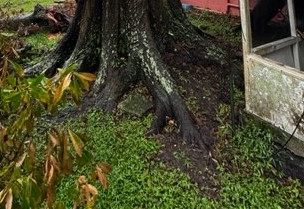
They can develop around the base of a tree and cause trouble slowly, sometimes for
years before a homeowner realizes anything is wrong. The tree may still have leaves. It
may still provide plenty of shade. From across the yard, it might look completely normal.
Meanwhile, a root may be pressing against the trunk or wrapping around part of the
tree.
For homeowners in Seffner, Brandon, Valrico, Plant City, Riverview, Dover,
Thonotosassa, and Mango, this is one of those tree problems worth knowing about,
especially if you have mature trees that were planted years ago.
What exactly is a girdling root?
Most healthy tree roots should spread outward from the base of the trunk into the
surrounding soil.
A girdling root grows differently. Instead of continuing away from the tree, it curves
around the trunk or crosses another important root. As both the tree and root increase
in size, the space between them becomes tighter.
Think about a tree trunk getting wider every year while a large root is pressed against
one side of it.
Eventually, that pressure can interfere with normal growth and create problems at the
base of the tree.
UF IFAS explains in its guide to common tree root problems that circling roots can
tighten around a tree as it grows and eventually girdle the trunk. The problem is often
connected with container grown trees and planting conditions. Gardening Solutions
Why can the problem take so long to notice?
This is what makes girdling roots frustrating.
You can live with a tree for years without realizing anything unusual is happening below
the mulch or soil.
The tree does not necessarily decline overnight.
You might first notice that one section of the canopy looks thinner. Maybe some
branches are producing fewer leaves. Perhaps the tree does not seem as vigorous as it
once did.
Those changes are easy to blame on drought, insects, age, or Florida weather.
Sometimes the real problem is closer to the ground.
UF IFAS notes that root defects can be difficult to identify because soil and mulch may
hide them. Crown thinning, dieback, swelling around the root collar, and other changes
can sometimes point toward a problem below the surface. Ask IFAS - Powered by EDIS
That is one reason Certified Arborist Services can be useful when a mature tree starts
changing and there is no obvious explanation.
Take a look at the base of the tree
You do not need to dig up your yard every time you inspect a tree.
Start by simply looking at where the trunk meets the ground.
A normally developed tree usually widens near the bottom rather than looking like a
straight telephone pole disappearing into the soil. That widened area is commonly
called the root flare.
UF IFAS has useful photos showing what a natural root flare should look like. It also
notes that when trees are planted too deeply, the normal flare may not be visible and
decline can take years to appear.
Walk around your tree and look for:
A large root wrapping around the trunk
Roots crossing tightly over one another
One side of the trunk that looks flattened
A root flare that is missing or buried
Soil piled high around the trunk
Thick mulch covering the base
Unusual swelling where roots meet the trunk
You may not see every girdling root from the surface, but these clues are worth a closer look.
Why planting depth matters
Sometimes the problem started long before you owned the property.
A tree may have been planted too deeply when the home was landscaped. Soil may
have been added later. Mulch may have been piled around the trunk year after year.
Roots need the right soil conditions to grow normally.
When a tree is buried too deeply, roots can grow toward areas where oxygen and
moisture conditions are more favorable. In some cases, those roots begin circling the
trunk instead of spreading outward.
UF IFAS specifically identifies deep planting as one condition that can encourage stem
girdling roots.
This also connects with another issue we recently covered: adding soil around an
established tree can create problems that are not immediately obvious.
If you are changing the grade of your yard, installing new landscaping, or bringing in fill
dirt, it is worth considering the existing trees before the work begins.
Our guide on protecting tree roots during landscaping projects explains why seemingly
simple yard improvements can affect mature root systems.
Do not automatically cut a large girdling root
Finding a root wrapped around the trunk does not mean you should grab a saw and cut
it.
That can create a second problem.
An established tree may already depend on that root for water, nutrients, or structural
support. Removing a significant root without understanding the rest of the root system
can stress the tree or affect stability.
The size of the root matters.
Its location matters.
How deeply it is embedded matters.
The condition of the trunk matters too.
UF IFAS provides specific guidance for evaluating and correcting girdling roots, including
situations where removal of a root may not be appropriate because the defect has
become severe.
For a small young tree, correction may be relatively straightforward.
For a large mature tree beside your house, driveway, pool cage, fence, or parking area,
the decision deserves more care.
Look at the rest of the tree too
A root should never be evaluated completely by itself.
Look up.
Has the canopy changed?
Are branches dying on one side?
Does the tree seem thinner than neighboring trees of the same type?
Has growth slowed noticeably?
Then look back down.
Is the trunk damaged near the soil?
Are mushrooms appearing around the base?
Is the tree beginning to lean?
Are roots lifting or showing decay?
A tree with one visible girdling root and a full healthy canopy is a different situation
from a tree with severe root problems, canopy decline, trunk damage, and dead limbs.
That is why an inspection should consider the whole tree.
We discussed the same idea in Why Mature Trees Need Regular Care Even When They
Look Healthy. A green canopy is encouraging, but it does not reveal everything
happening at the trunk or below ground.
Can a tree with girdling roots be saved?
Sometimes, yes.
The answer depends on how advanced the problem has become.
A smaller girdling root may be correctable before it causes major damage. In other
situations, an arborist may recommend monitoring the tree or carefully addressing the
root problem.
There are also cases where the damage has progressed too far.
If the trunk has been seriously compressed, roots are badly compromised, decay is
present, or the tree has developed structural concerns, saving it may no longer be
practical.
That does not mean every tree with a strange looking root needs to come down.
It means the condition should be evaluated before making a decision.
When a tree is still healthy and structurally sound, preservation may make sense. When
serious defects are present, Tree Removal may eventually be the safer option.
Trimming will not fix a root problem
Homeowners sometimes notice canopy decline first and assume the tree simply needs
trimming.
Proper Tree Trimming and Pruning can be valuable for dead branches, clearance,
structure, and routine tree care.
But pruning cannot remove the underlying cause of a root problem.
If branches are dying because the tree is struggling below ground, repeatedly cutting
back the canopy without investigating the roots may miss what is actually happening.
This is another reason to diagnose the problem before deciding on the work.
Pay attention before the tree becomes an emergency
Girdling roots are a good example of why tree care is not always about reacting to
obvious damage.
Sometimes the best time to look at a tree is while it still appears mostly healthy.
Walk around your mature trees a few times each year. Look at the trunk. Look at the
root flare. Notice changes in the canopy. Pay attention when landscaping work changes
the soil around them.
Florida trees already deal with intense heat, heavy rain, saturated ground, and storm
winds. A tree with a compromised root system may deserve additional attention before
severe weather arrives.
If something around the base does not look right, you do not have to diagnose it
yourself.
Have someone who understands tree structure take a closer look.
Protecting mature trees starts at the roots
A beautiful canopy begins with a healthy root system.
Girdling roots can be easy to overlook because much of the problem develops where
homeowners rarely look. By the time the canopy shows obvious decline, the root issue
may have been developing for years.
If you have a mature tree in Seffner with circling roots, a buried root flare, unusual
trunk growth, or unexplained canopy decline, All Your Way Tree Service can inspect the
tree and help determine what makes sense for the property.
The goal should not automatically be removal.
It should be understanding what is happening before a manageable tree problem
becomes a much bigger one.
Visit All Your Way Tree Service to schedule an evaluation for trees on your property.


Comments